Thursday, February 17, 2011

On the Egyptian Revolts

       I congratulate the citizens of Egypt on their successful overthrow of the government and of President Mubarek. They were completely within their rights to strike and make their plight known; especially in this day and age, seeing as governments everywhere are much more lenient towards protestors than they was in my day. If I were alive today, I would have undoubtedly gone to support the Egyptians’ cause. It is my belief that the opinion of the general public is what matters most in a nation. It does make up over half of the country, after all. If it is not content, then a change in the form or leader of government must occur to satisfy its needs.

       The revolutions I took part in during my lifetime were all directed toward creating better nations. The events in Egypt were also exactly that – the first steps in the rebirth of a superior Egypt. I hope that those who took part in the strikes against Mubarek are successful in finally creating a government that does cater to their needs.


Americanthinker.com, Guardian.co.uk

On the American Civil War

       Not many know this about me, but I once offered my services to President Abraham Lincoln as a military leader in the Civil War. I was offered a commission as a Major General, but I requested that I be Commander-in-chief. I also hoped that Lincoln would declare the objective of the war the abolition of slavery. President Lincoln refused to do so, as he feared that he might cause unrest within the already divided nation. Naturally, I understood why he replied the way he did. Yet only year after my request, I heard happily that Lincoln delivered the Emancipation Proclamation. I wrote to him right away, telling him that the title of "great emancipator" was greater than the glory that came with any crown. I was delighted that Lincoln had made such a bold move, and even today continue to look upon the growing equality of races and sexes with favor.

       In my day, I often attended meetings regarding suffragist movements or the freeing of slaves. I do believe that no sex nor ethnicity is above nor under any other, and take much pleasure in the fact that many today see the world as I did so many years ago.


Wikipedia, Reformation.org

Young Italy

       La Giovine Italia was a political movement created by my friend Giuseppe Mazzini. Young Italy's goal was an issue I held very close to heart - the unification of Italy. When I was a child, my hometown of Nice was traded away to France. It is because of this event that I sought a unified Italy throughout my adult life. When I heard of Mazzini's idea, I of course offered my full and immediate support.
       Mazzini's supporters and I attempted a few uprisings in support of the liberalization of Italy, but were quickly suppressed. However, our efforts were not all in vain; Young Italy inspired the beginning of the Risorgimento, another attempt at Italian unification and liberalization which I participated in.
       Unlike the efforts of Mazzini and his followers, I am happy to be able to say that the Risorgimento did actually gradually achieve a certain level of Italian unification.
One of Young Italy's battles in hopes of unification


Wikipedia, Spielvogel, Talktalk.co.uk

Anita

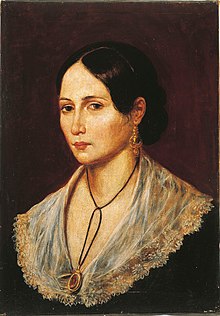
       Although I did marry another woman after Anita's death, Anita was and always will be the most important woman in my life. I fell in love with her at first sight at the Battle of Tatters. She was not only my wife, but also a precious and brave comrade who always stood by my side, even in the most dangerous of situations. She left her previous husband to run away with me and support me in every revolution I took part in.
      Anita was an exceptional woman in every way - she knew how to wield a sword as well as any man in the Redshirts, but at the same time was the most caring mother and most attentive housewife I knew.

       My first and most loving wife eventually died in Mandriole while retreating from the French. Her death was devastating, but the one comfort I took in her passing was the fact that she died in my arms.


Wikipedia, Suite101.com

Introduction

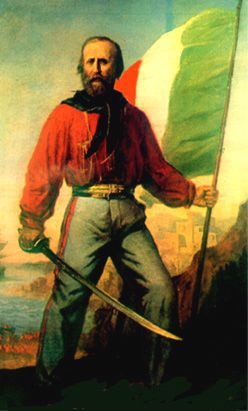
       My name is Giuseppe Garibaldi, and I was born in Nice on July 4, 1807. I am remembered today as a great political and military figure. During my lifetime, I took up a number of causes in various areas including several South American countries and my homeland - Italy.
       The first revolution I joined was the Carbonari association, which supported my friend Giuseppe Mazzini's idea of "Young Italy." However, our efforts failed and I was exiled from the land I had tried so hard to defend. I fled to Brazil, and joined another political group called the "tatters." It was during my association with the farrapos that I met the beautiful Ana Ribeiro da Silva.
A statue of Anita and I in Brazil
        From that day on, Anita fought alongside me and my comrades during every battle, and we were married in Montevideo in 1841. Anita was also the one who introduced me to my trademark clothing - the red shirt and gaucho. I loved my family dearly, but even my marriage to Anita and the birth of four children were not enough to keep me away from the various revolutionaries who called for my leadership.
In 1842, I raised an Italian legion in alliance with liberal Uruguayans and Argentinians in the Uruguayan Civil war. I was pleased with our numerous triumphs, but the events in Italy continued to bother me. Therefore, I moved to Rome to support the recently declared Republic against the French. The French forces were much too powerful, and I withdrew with a number of troops to Venice. My comrades and I continued to retreat, and during the travel, my wife Anita died with our fifth child in her stomach.
       I was distraught over the loss of my wife, but the Piedmontese government forced me to emigrate, so to America I went. America yielded great financial profit for me through trade and factory work, but once again, my homeland called to me.
       Accompanied by my "Redshirts," I joined revolts in the Kingdom of the Two Sicilies and triumphed over all who stood in my path. I entered Naples and was in the midst of  battle with the French when the Piedmontese arrived. I had hoped to completely unite Italy myself, but I had no problem with an Italian unification under the Piedmontese crown, so I turned over the lands I had captured to them.
       My battle with the French army in Naples was undoubtedly the largest I had ever fought, but even when I started to enter my 60s, I managed feats such as helping lead the Italians in their alliance with Prussia in the Austro-Prussian War.
A statue of myself erected in New York City
              On June 2, 1882, at the age of 74, I died on my deathbed while gazing at the sea. It seems odd to me that I, who had fought in so many wars, would die such a remarkably peaceful death. Yet I do not doubt that without my efforts, Europe would be a very different place today. I am even bold enough to say that without me, none of the revolutions I participated in would have succeeded.


Spielvogel, Wikipedia